Cart
0
$0.00

Emotional Intelligence (EQ) is the ability to recognize, understand, manage, and use emotions effectively—both our own emotions and those of the people around us.
IQ helps us think well. EQ helps us respond well.
EQ is commonly understood through five key areas:
We don't leave our emotions at the door when we go to work, lead a team, parent our children, enter a marriage, or make an important decision. Emotions influence how we think, communicate, react, and relate.
A person might have excellent knowledge and technical skills yet struggle because they become defensive when corrected, react impulsively under pressure, fail to read the room, or have difficulty maintaining relationships.
EQ helps us create a space between what we feel and how we respond.
People with stronger emotional intelligence tend to be better equipped to manage stress, communicate effectively, navigate conflict, understand others, build healthier relationships, and lead themselves before attempting to lead others.
And EQ is not about suppressing emotions or being calm all the time. Anger, fear, sadness, excitement, and frustration all carry information. Emotional intelligence is learning to understand that information and choose an appropriate response.
A simple way to remember it:
Know your emotions.Manage your emotions.Understand others' emotions.Respond wisely.
That is why the purpose of an EQ Scorecard is not to label us as emotionally intelligent or unintelligent. It helps us identify where we are strong and where we have room to grow.
EQ is less about controlling what we feel and more about choosing what we do with what we feel.
EMOTIONAL INTELLIGENCE TEST - HOW TO SCORE
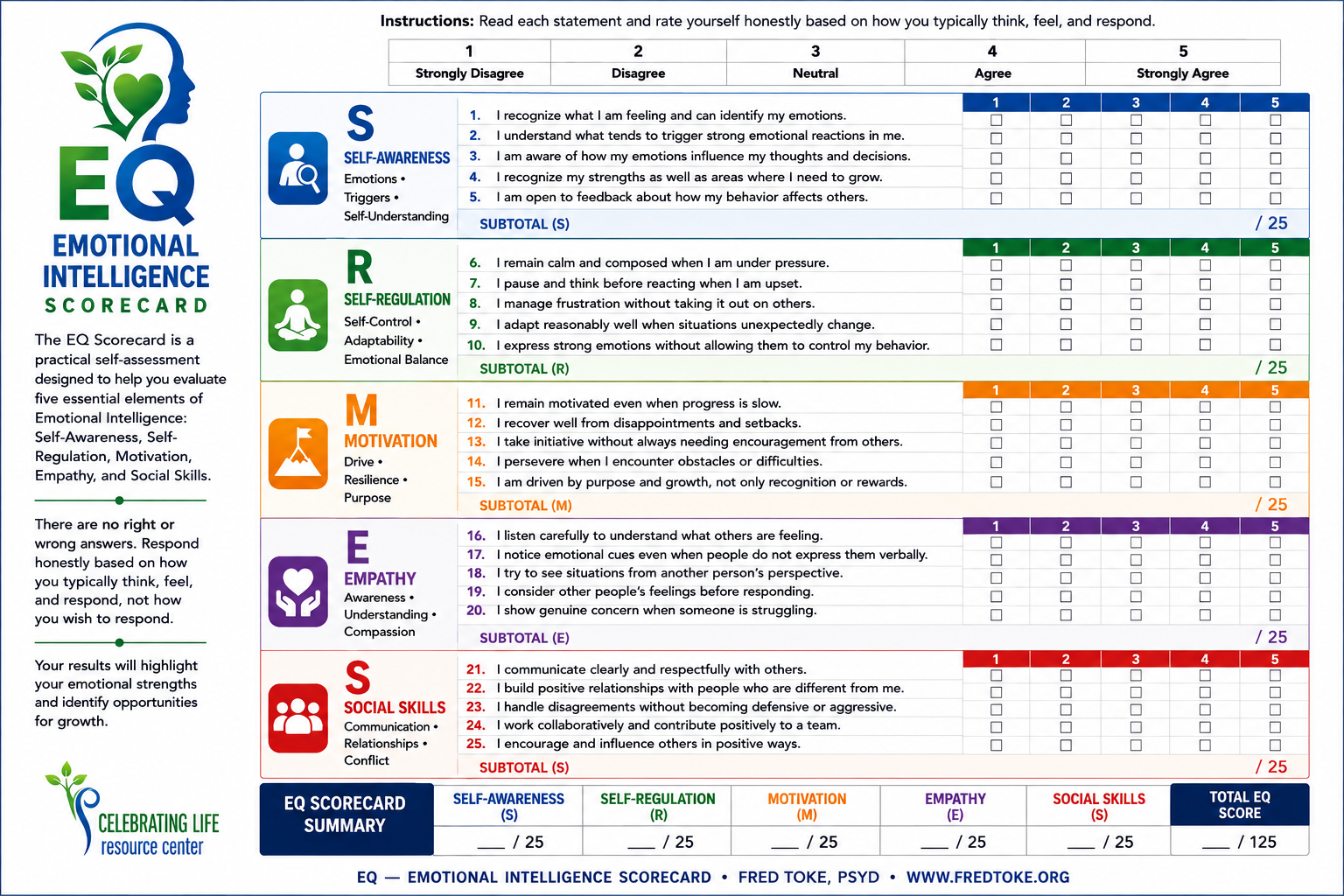
Complete all 25 statements, rating yourself from 1 to 5 based on how you typically think, feel, and respond. Answer honestly rather than choosing how you think you should respond.
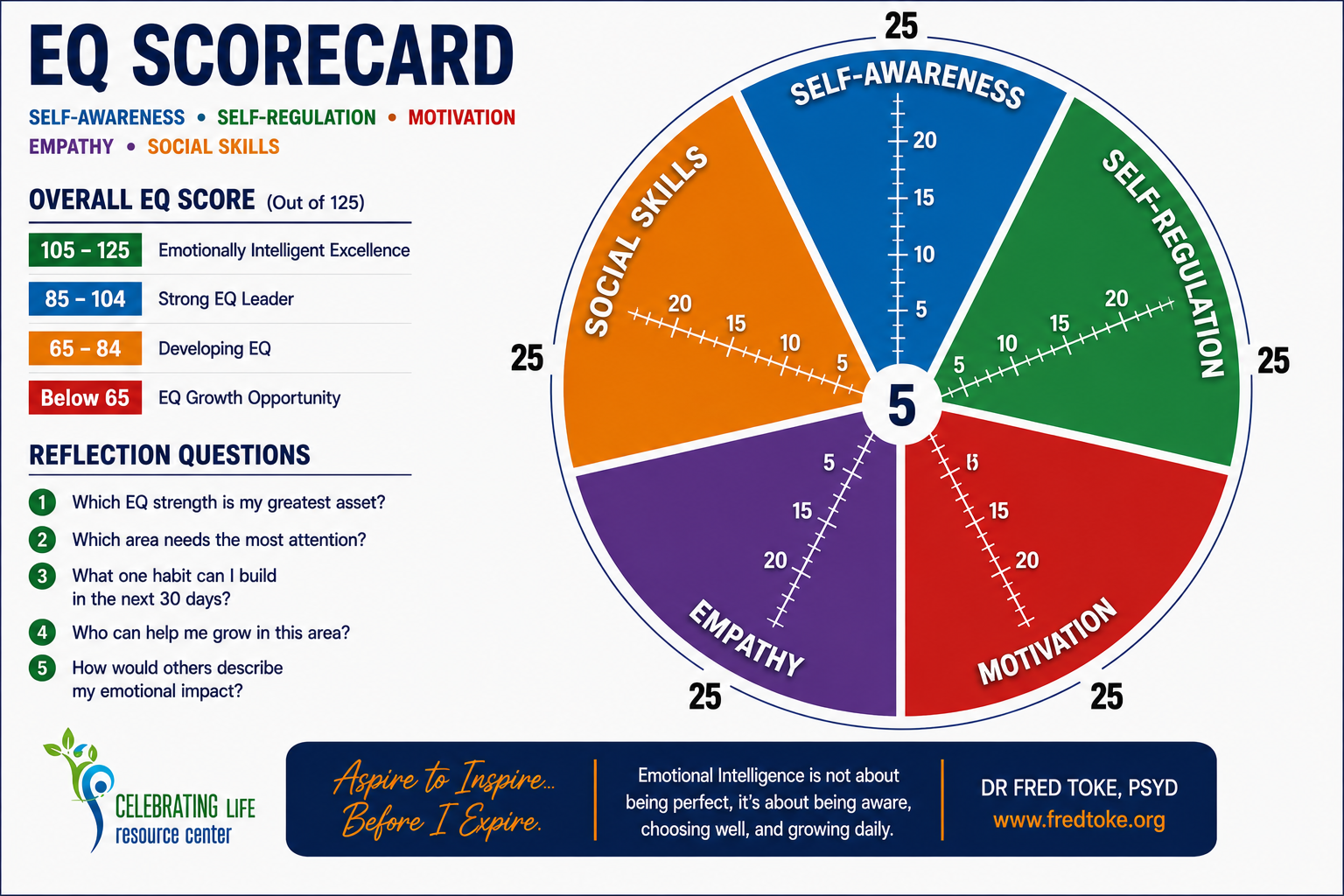
Add the five responses within each EQ area. Each area—Self-Awareness, Self-Regulation, Motivation, Empathy, and Social Skills—has a possible score from 5 to 25.
Next, transfer each subtotal to the corresponding section of the EQ wheel. Begin at 5 in the center and mark your score along the line toward 25 at the outer edge. Once all five scores are marked, connect the points to create your personal EQ profile.
Finally, add all five scores for your Overall EQ Score out of 125.
The shape of your profile is often more useful than the total score. Look for areas that extend farther outward—these represent your relative strengths. Areas closer to the center highlight opportunities for development.
Use the reflection questions to identify one area you want to strengthen and one practical action you can begin working on.
The goal is not a perfect score. The goal is greater self-awareness and intentional growth.